

–
By: Jennifer Hart—————————————————————————————————————Updated: Mar 14, 2026
The difference between a manuscript that resonates and one that falters is rarely a matter of prose quality. In the competitive landscape of publishing houses, thousands of technically proficient novels are rejected every year, not because the writing is poor, but because the structural integrity is compromised. A story is not a collection of observations or a linear report of events; it is a high-fidelity emotional system. To build a narrative that survives the scrutiny of the world’s most demanding editors, one must look past the “skin” of the story, the style and voice, and master the “nervous system”: the underlying architecture of human transformation.
Inside This Masterclass: Key Narrative Breakthroughs
-
How to identify the “Internal Saboteur” that paralyzes your protagonist’s growth.
-
The “Therefore/But” rule: Engineering a high-stakes kinetic chain of causality.
-
Transforming your character from a “Wanderer” to an “Architect” at the Midpoint Pivot.
-
Subtextual Engineering: Mastering the discrepancy between dialogue and emotion.
-
The Neurobiology of Reading: Managing Cortisol, Dopamine, and Oxytocin loops.
-
Temporal Tightening: Using “Sentence Fracking” to control pacing and tension.
-
The Symmetrical Echo: Closing the narrative loop for a permanent thematic payoff.
The following analysis outlines the fifteen definitive movements of a masterpiece. These steps represent a synthesis of structural logic and psychological resonance, designed to transform a raw premise into a work of permanence.
1. The Internal Saboteur – Defining the Psychological Deficit
Every compelling narrative begins with a deficit. In professional storytelling, we do not start with a hero who is ready for the journey; we start with a character who is fundamentally ill-equipped for it. This is the Internal Saboteur. This is not merely a “character flaw” in the casual sense; it is a functional survival mechanism, usually born from a past trauma, that the protagonist believes is necessary for their safety, but which is actually the primary barrier to their growth.
When assessing manuscripts, the first thing an editor looks for is the friction between what a character wants (the external goal) and what they actually need (the internal healing). If a character believes that “vulnerability is a weakness,” that belief is their Saboteur. The entire plot is effectively an engineering project designed to make that belief too expensive to maintain. Without a clearly defined Saboteur, a character has no arc; they are simply a person to whom things happen.
2. The Strategic Vision – The Physics of Friction
A premise is a suggestion; a Strategic Vision is an engine. To move a manuscript from the “slush pile” to the production desk, the core conflict must be expressed as an equation of friction. This goes beyond the traditional elevator pitch and looks at the mechanical requirements of a sustained narrative.
Every successful project rests on four high-pressure pillars:
- The Flawed Catalyst: A protagonist defined by their specific psychological deficit.
- The Inciting Pressure: An event that renders the status quo impossible.
- The Desperate Objective: A tangible, high-stakes goal.
- The Antagonistic Mirror: A force that represents the dark conclusion of the hero’s Internal Saboteur.
If this equation does not imply a fundamental internal shift, the story lacks kinetic energy. Action without an underlying internal stake is merely noise. A masterpiece is created when the external “ticking clock” is inextricably linked to the character’s internal “moment of truth.”
3. The Molecular Core – Establishing the Status Quo
There is a common misconception that a story should begin at the peak of the action. However, without a clearly established “Before,” the “After” has no weight. The first movement of a professional blueprint is dedicated to the Molecular Core, the demonstration of the protagonist’s life under the weight of their Internal Saboteur.
We must see how the character’s flawed belief system is already poisoning their reality. This is not “world-building“ for the sake of scenery; it is “stakes-building.” If the reader does not understand the cost of the hero staying exactly as they are, they will not care when the hero is forced to change.
4. The Disruption – The 12% Surgical Strike
Around the 12% mark of a manuscript, the narrative must land its first major blow. This is the Disruption. It is not a random accident; it is a surgical event designed to target the hero’s specific psychological wound.
In my experience reviewing hundreds of submissions each year, I’ve found that the most common structural failure is a Disruption that lacks personal stakes. If the event doesn’t make the “Normal World” untenable, the story loses its forward velocity. The Disruption is the moment the universe notifies the protagonist that their old tools, their Saboteur, are no longer sufficient for the world they are about to enter.
5. The Threshold of Commitment
By the 25% mark, the protagonist must transition from a victim of circumstance to an active participant. This is the Threshold of Commitment. The hero leaves the familiarity of the first act and steps into the “Special World” of the second.
It is vital that this transition is an active choice. Even if the choice is made out of desperation, the character must plant their feet and decide to engage with the conflict. They enter the second act still clinging to their Saboteur, mistakenly believing they can achieve their goal without undergoing internal change.
6. The Kinetic Chain – The “Therefore/But” Rule of Causality
Once the threshold is crossed, the narrative enters the “Crucible.” This is where many manuscripts fail, succumbing to the “Sagging Middle.” The professional fix is the application of the Kinetic Chain.
A story must move through causality, not chronology. We replace the word “and” with “therefore” or “but.” Every scene must be a direct consequence of the one before it.
- The hero finds a clue; therefore, he is pursued by the antagonist’s henchmen.
- He escapes the henchmen, but he loses his primary source of information in the process.
This creates a weighted chain of events. During a developmental edit, if I find a scene that can be removed without collapsing the scenes that follow, I know that scene is dross. In a world-class blueprint, every moment is an essential link in the chain.
7. The Midpoint Pivot – From Reaction to Action
The 50% mark is the heart of the narrative engine. This is the Midpoint Pivot, where the protagonist stops reacting to the antagonist’s moves and starts making their own. This is usually triggered by a “Moment of Truth”, a piece of information or an event that makes the Internal Saboteur impossible to ignore.
I’ve often seen authors struggle with characters who feel “flat” in the second act. The issue is almost always a missing Midpoint Pivot. This is where the character stops being a “Wanderer” and becomes an “Architect.” They catch a glimpse of their true “Need” (the truth), and while they aren’t fully healed yet, they shift their strategy from survival to confrontation.
8. The Descent and the Total Collapse
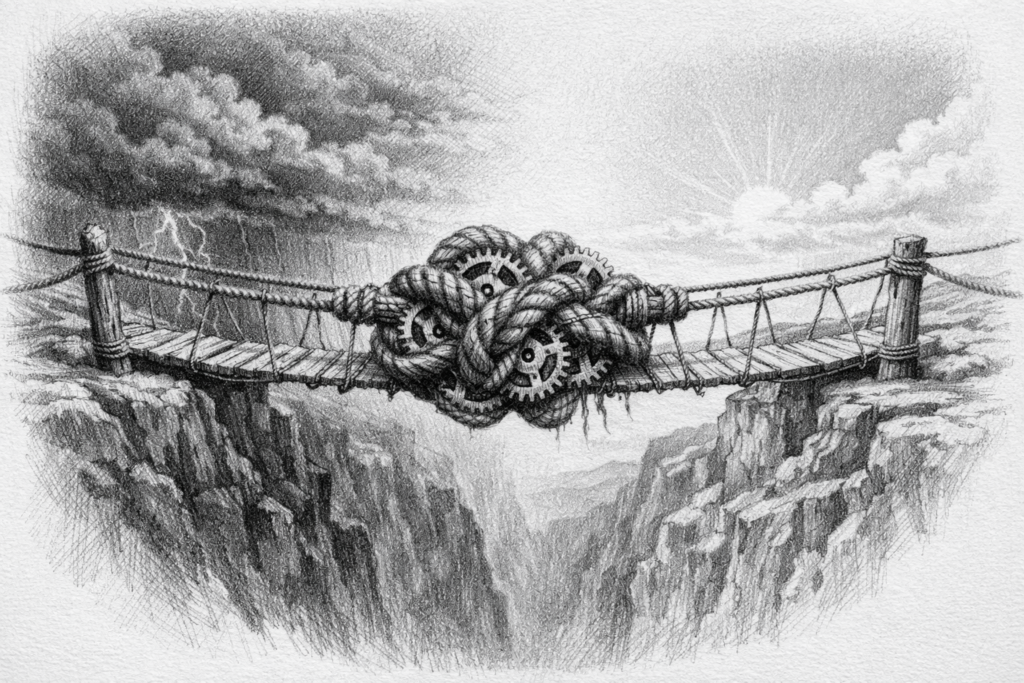
As the narrative accelerates past the 60% mark, the pressure must become absolute. In professional developmental editing, we refer to the transition into the final act as the Total Collapse. Up to this point, the protagonist has tried to integrate their new understanding with their old world, but at approximately the 75% mark, the “Internal Saboteur” must fail them completely.
This is the “All Is Lost” moment, and its function is mechanical: it strips the character of every psychological defense. The external goal must appear unreachable, and the character must be forced to stand in their rawest, most vulnerable state. It is a moment of profound darkness that serves as the necessary prerequisite for the final transformation. Without this collapse, the eventual victory feels unearned; it is the “death” of the old self that allows the new, authentic self to emerge.
9. The Three-Stage Climax – The Mechanics of Resolution
A climax is often misunderstood as a sequence of high-intensity action. However, a world-class resolution is actually a three-stage psychological process:
- A. The Breach: The character engages with the final obstacle, entering the “heart of the storm.”
- B. The Moment of Truth: This is the hinge of the entire manuscript. The character is offered a way out, a chance to succeed by returning to their old “Internal Saboteur.” They must make a choice that costs them something significant, choosing the internal “Need” over the external “Want.”
- C. The Resolution of Conflict: Only after the internal choice is made can the external victory occur. The protagonist wins not because they have become stronger, but because they have become Whole.
This symmetry ensures that the ending isn’t just a plot resolution, but a thematic payoff that resonates with the reader on a primal level.
10. The Symmetrical Echo – The New Normal
The final movement of the architecture is the Symmetrical Echo. A story should end with a reflection of its beginning. If the opening showed the character trapped by their psychological deficit, the final pages must show them navigating a similar environment, but with their newly acquired Truth.
This is what we call the “New Normal.” It provides the reader with a tangible sense of the journey’s impact. The world itself may be scarred by the external plot, mirroring the transformation within the character’s soul. This completion of the circle is what elevates a book from a “read” to an “experience.”
The Architecture of the Unspoken – Subtextual Engineering
Beyond the ten steps of the plot lies the most sophisticated layer of storytelling: Subtextual Engineering. In my years reviewing manuscripts from authors at every level of experience, I’ve found that the most “expensive” real estate in a novel is the space between the lines.
Subtext is the tension between a character’s external mask and their internal reality. Every scene must be mapped with a “Discrepancy Principle“: what is being said versus what is being felt. If two characters are arguing about a broken vase, the scene isn’t about the vase; it’s about the decades of unspoken resentment or the desperate need for forgiveness. By architecting these undercurrents, we ensure the narrative has the “weight” of reality rather than the thinness of a script.
The Neurobiology of the Reader – Why Structure Works
To understand why this architecture is effective, we must look at the biological response it triggers. Storytelling is, at its core, a form of neuro-management.
- Act III (The Resolution): Triggers Oxytocin. The thematic Truth and the character’s vulnerability reward the reader’s emotional investment, creating a lasting bond with the story.
- Act I (The Setup): Triggers Cortisol. The introduction of a problem and a threat creates focus and urgency.
- Act II (The Struggle): Triggers Dopamine. The constant cycle of “Therefore/But” causality creates a reward system, keeping the reader in a state of perpetual anticipation.
When a manuscript fails, it is often because it has failed to manage these chemical loops. A story that provides answers too quickly kills the dopamine; a story that lacks a personal wound fails to trigger the oxytocin.
The Professional Audit – Ensuring Structural Integrity
Before a blueprint is finalized, it must undergo a forensic audit. This is the stage where we move from the “what” to the “how.” Every scene is stress-tested:
- Does this moment move the plot, the character arc, and the theme simultaneously?
- Is there a clear causal chain where every action is a consequence of a prior choice?
- Is the antagonist a true philosophical mirror of the hero’s struggle?
By the time the prose begins, the logic should be unshakeable. This preparation does not stifle creativity; it provides a sanctuary for it. When the heavy lifting of structure is complete, the author is free to focus entirely on the nuance of voice and the rhythm of language.
A masterpiece is not an accident. It is an engineered inevitability.
11. The Pulse of the Narrative – Action and Sequel
One of the most frequent notes I leave in the margins of a developmental edit concerns the rhythm of the scenes. A common structural failure is what I call “The Breathless Sprint”, a manuscript that moves from one high-intensity event to the next without allowing the characters, or the reader, to process the emotional fallout. In professional storytelling, we manage this through a mechanical cycle known as Action and Sequel.
Every scene of Action must contain three sub-movements: a Micro-Goal, a Conflict, and a Setback. The hero wants something in the moment, they fight for it, and they fail (or succeed at a terrible cost). However, the story is not built by action alone. It is built by the Sequel, the quiet aftermath where the character reacts emotionally, processes the dilemma, and makes a new decision.
I often find that the soul of a novel is found in these sequels. It is where we see the hero’s “Internal Saboteur” struggling to adapt to the new reality. If you skip the sequel, you skip the humanity. You aren’t writing a story; you’re writing a police report.
12. Information Management – The Art of the Reveal
Information is the primary currency of a novel. If you spend it all in the first act, you go bankrupt by the second. Masterful architecture requires a rigorous Information Ledger. You must track not only what the protagonist knows, but what the reader thinks they know.
In the early years of my career as a copy editor, I became obsessed with the logic of reveals. I realized that a twist is only effective if the seeds were planted in plain sight, yet obscured by the reader’s own assumptions. This is Misdirection Architecture. You plant a “clue” as a mundane detail in the Normal World (Step 3), challenge its meaning in the Crucible (Step 6), and reveal its true significance only at the Moment of Truth (Step 9).
A professional strategy is to close one narrative loop while simultaneously opening two more. This creates an “Overlapping Loop” effect, ensuring that the reader never feels they have reached a safe stopping point. If the reader feels they have all the answers at the 60% mark, you have lost the tension.
13. Subplot Integration – Thematic Mirrors
A 100,000-word manuscript cannot be a solo performance by a single plot line. It must be a symphony of intersecting forces. However, subplots are not “filler” designed to pad the word count; they are Thematic Mirrors.
Each secondary storyline should either reinforce the protagonist’s journey or offer a cautionary tale. If your hero’s “Internal Saboteur” is a fear of betrayal, a subplot might involve a secondary character who faces a similar betrayal but chooses the “wrong” path, refusing to change and eventually succumbing to their wound. This heightens the stakes of the primary arc.
Editors review a structural map and look for how the “Pinch Points” of the subplots align with the major beats of the main story. If a subplot concludes in a vacuum, it is a narrative leak. It must collide with the main plot at the climax, contributing its own weight to the final resolution.
In my transition from copy editing to developmental work, I had to learn a hard lesson: you cannot “fix” a broken story with better adjectives. I spent months early in my career trying to polish prose in manuscripts that were structurally hollow. It was like trying to paint a house while the foundation was sinking into the mud. Now, I refuse to look at a single line of prose until the 4,500-word structural map is airtight. I tell my authors: “Give me the logic first; we’ll find the beauty later.”
14. The Mechanics of Pacing – Temporal Tightening
Pacing is often treated as an intuitive “feeling,” but it is actually a mechanical output of Scene Density. As you move toward the climax, the “intervals” of the story, both in terms of page count and fictional time, must become shorter.
In Act I, you might cover weeks in a single chapter. By the time you reach the 75% mark, a single chapter might cover only minutes. This is Temporal Tightening. It creates a physiological sense of urgency in the reader. The “breaths” between actions become shorter, and the stakes feel more claustrophobic.
As a professional architect, you must audit your map for “dead time.” Any period where the character is waiting, traveling, or reflecting without a new decision being made is an opportunity for the reader to disengage. Every page is expensive real estate. If a scene doesn’t move the Plot, the Character Arc, and the Theme simultaneously, it must be reimagined or removed.
15. The Forensic Audit – Stress-Testing the Soul
Before we consider a manuscript ready for the drafting phase, it must pass through the final Forensic Audit. This is where we look for the “Points of Failure” that even experienced writers often miss.
One such point is the Antagonist’s Motivation. A “bad guy” who is evil for the sake of being evil is a narrative cliché. A world-class antagonist must be the hero of their own story. Their goal must be as logical and urgent to them as the hero’s goal is to the hero. Ideally, the antagonist represents the ultimate conclusion of the hero’s Internal Saboteur. They are the person the hero will become if they do not find the strength to embrace the Truth.
When these two forces collide at the Moment of Truth (Step 9), it shouldn’t just be a battle of strength; it should be a Dialogue of Values. The hero isn’t just fighting to win; they are fighting to prove that their new way of living is viable.

A Final Perspective
Over the last few years, my desk has been a revolving door for manuscripts from every corner of the globe. I see established authors struggling to recapture the magic of their debuts, and I see debut novelists paralyzed by the sheer scale of their own ambitions. If there is one recurring phenomenon that haunts both groups, it is the fear that “too much planning kills the muse.”
In my experience, spontaneity in a first draft is often just the “Internal Saboteur“ trying to protect the author from the hard work of the Truth. When you write without a blueprint, you aren’t being “free”, you are simply guessing. And guessing leads to the kind of structural drift that requires years of painful rewriting to fix.
Mastering this level of structural integrity is not about following a rigid formula; it is about building a sanctuary for your creativity. When the foundation is poured and the load-bearing walls are in place, you are finally free to decorate. You can spend your energy on the rhythm of your sentences, the texture of your settings, and the haunting subtext of your dialogue, because the “logic” of the story is already unshakeable.
Every month, when I sit down to evaluate a new batch of submissions, I am not looking for a “good story.” I am looking for a vision that feels inevitable. I am looking for a book that feels like it had to be written this way. By investing the time to architect your narrative to this degree, you are doing more than just planning a book, you are ensuring that your work possesses the gravity and the permanence required to survive in the hands of a reader.
Your blueprint is ready. The site is cleared.
Now, go build your masterpiece.